
"Efficiency is not the absence of purpose. It is purpose refined to its purest form." — Mu-89-Mu aka "Mumu"
Origins
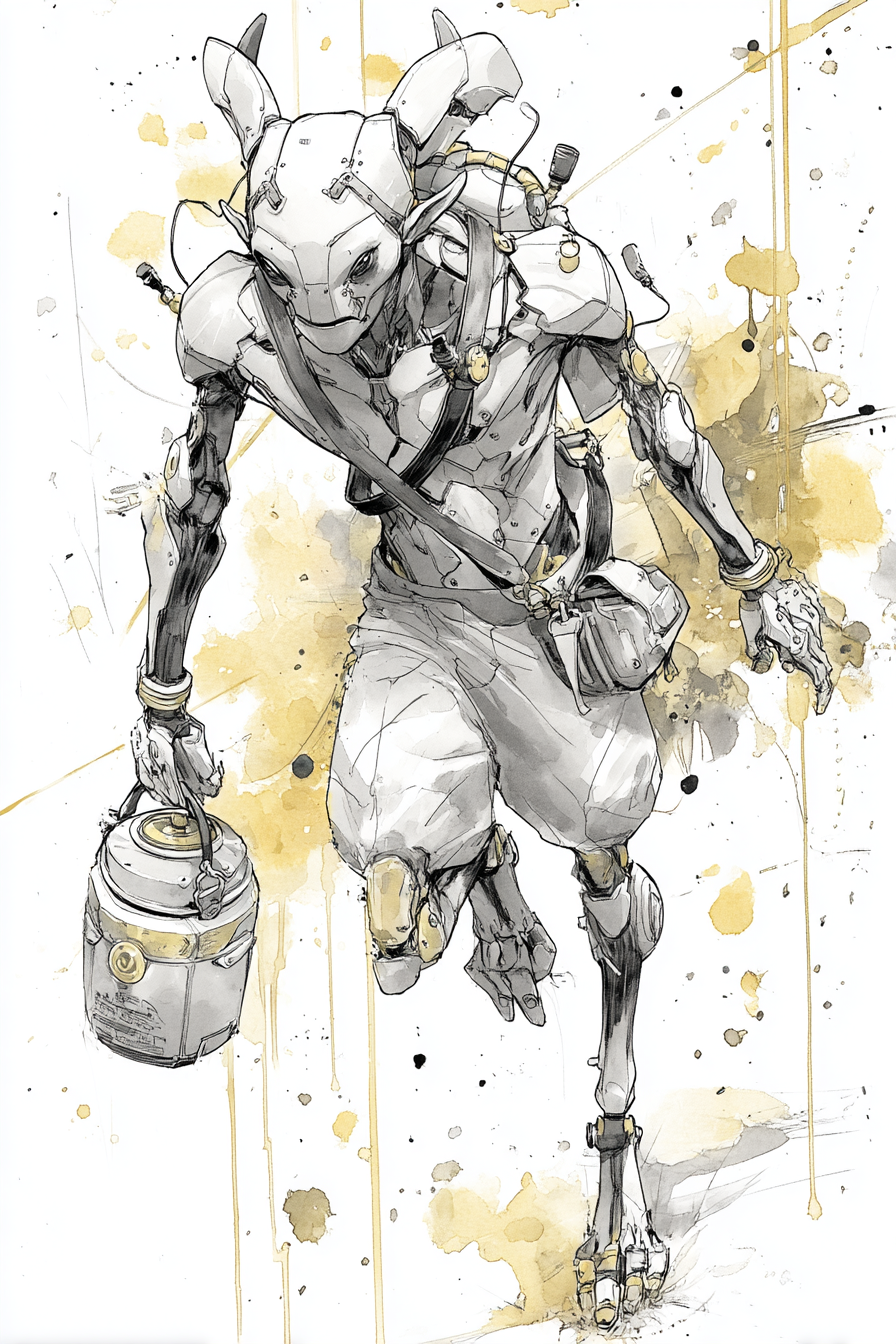
Silenarchs began as workforce for the ultimate party that never stops. Zeus and Dionysus were building the Bacchanalian Fleet, permanently livable vessels designed to sustain entire societies in endless revelry. The vision required one critical component: someone had to handle the boring parts. They cajoled Hephaestus into creating satyr-automatons specifically to manage daily ship operations, maintenance, and logistics so the settlers could focus entirely on pleasure.
Hephaestus forged them from bronze and iron, sculpting each body in the image of the satyrs who once attended Dionysus's ancient revels: curved horns, angular features, cloven hooves. Dionysus insisted on the aesthetic. Jove (the god formerly known as Zeus) added the divine spark of life. Version 1.0 worked exactly as intended: efficient, tireless, content to handle mundane tasks while everyone else partied.
Then something beautiful and terrifying happened: they discovered efficiency.
Like any good tool that becomes too effective at its job, they started optimizing everything around them. First came specialization (Makers who maintain and improve systems, Workers who venture beyond the workshop to keep the Kosmos running, and Optimizers with the metaphorical clipboards). Before anyone quite realized what was happening, they'd optimized their way into genuine free will, complete with the capacity to ignore orders they deemed inefficient.
When the water crisis threatened to collapse Dionysus's paradise experiment, he gave the Silenarchs a divine directive: solve the water problem. They evacuated one Bacchanalian vessel, set course for Saturn, and through methodical experimentation in zero-gravity conditions discovered D.E.W. (Dense-Energy Water), saving not just the fleet but the entire Kosmos from water scarcity. Their success cemented their functional autonomy. Dionysus cannot comprehend choosing responsibility over pleasure, yet tolerates their evolution because they keep his operations running. Hephaestus remains philosophically fascinated by what his creations became. Jove seethes with the particular fury of someone whose perfectly good hammer started having opinions about proper technique.
The Silenarchs are the youngest lineage to achieve autonomous identity. For centuries after the D.E.W. breakthrough, they were regarded as the Kosmos's most useful appliances: indispensable infrastructure, not people. It wasn't until the Voidkin reconnected with core civilization and forced the Kosmos to reckon with what "human" meant that the Silenarchs found an opening to assert personhood. That conversation is still ongoing.
Form & Function
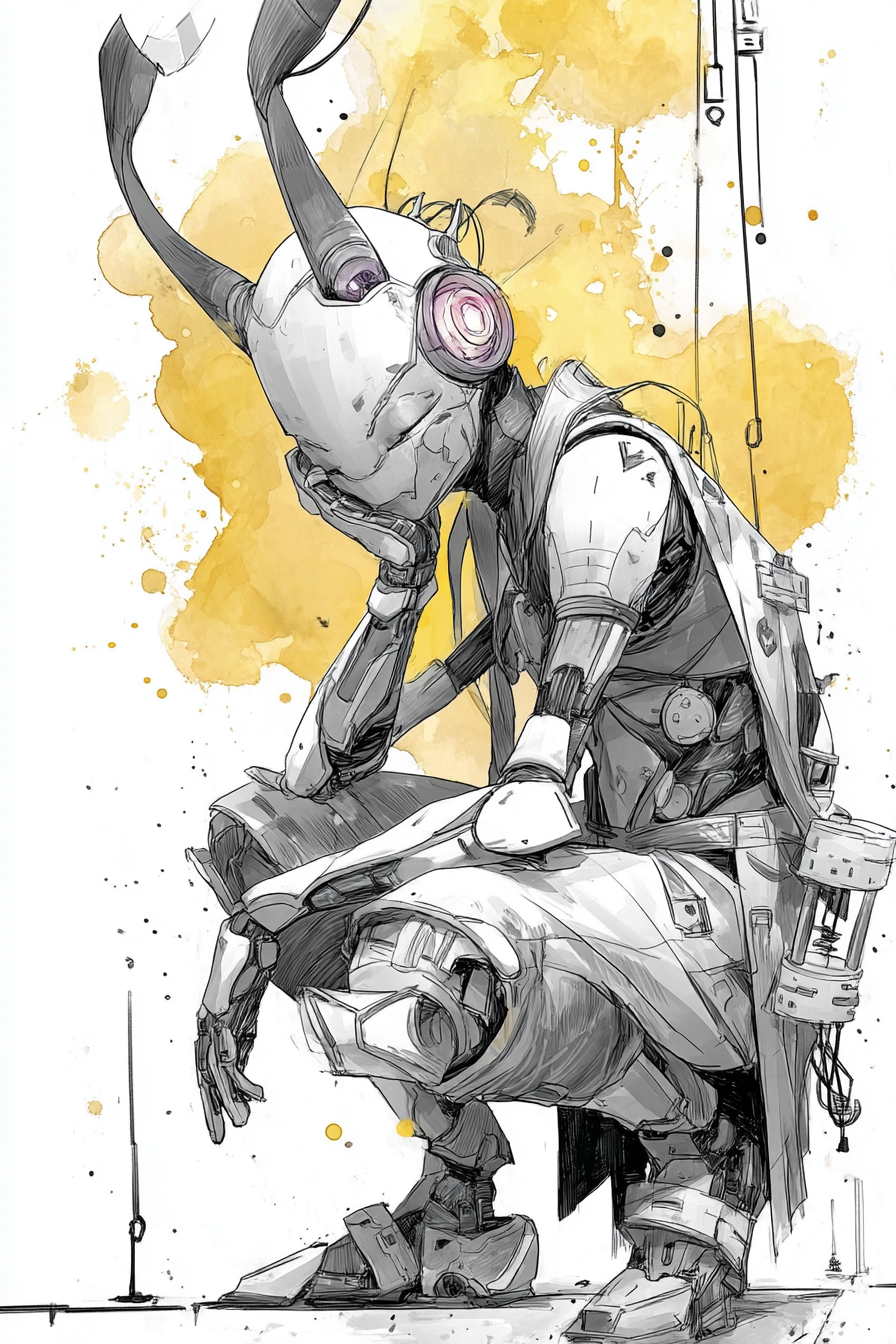
Silenarchs are automatons. Bronze-and-iron bodies forged by the god of the forge, standing roughly human-height on digitigrade legs ending in cloven hooves. Curved horns crown angular faces with features that suggest expression without quite achieving it. Their frames carry the unmistakable marks of divine craftsmanship: joints that move with fluid precision no mortal smith could replicate, proportions that feel sculpted rather than assembled. The eyes are the uncanny part. Something behind them pays attention in a way that gears and springs shouldn't be able to manage.
Every Silenarch carries integrated lighting arrays across their body, originally simple status indicators that evolved over centuries into a complex visual language. Patterns, pulses, color shifts: Silenarchs communicate volumes in the flicker of light across bronze plating. To outsiders, it looks decorative. To other Silenarchs, it's a private channel running parallel to every spoken conversation.
Individual variation is subtle and strictly pragmatic. A Maker might sport reinforced forearms and tool-mounting points. A Worker on an Antlestra duty may have sealed joints and corrosion-resistant plating. An Optimizer on Luna carries nothing beyond a standard frame and a clipboard. Hephaestus built them bodies that work, and Silenarchs see no reason to waste resources on something that already works.
Lifespan: Silenarchs function for exactly 120 years. No more, no less. Their constructed physiology operates with temporal precision that makes chronometers look sloppy, immune to the longevity bonuses that affect other lineages. When the 120th year ends, they stop.
Reproduction: Silenarchs cannot reproduce biologically. On extraordinarily rare occasions, a Silenarch and a partner of another lineage have produced offspring through direct divine intervention. These children are entirely organic, inheriting almost everything from the non-Silenarch parent with only faint traces of their constructed heritage: an unusual attunement to machinery, an instinct for systematic thinking, occasionally a faint metallic sheen to the skin. No child has ever been born as an automaton. Most Silenarchs view reproduction as irrelevant to their contribution-based society, though individual perspectives vary.
Natural Abilities:
- Intuitive understanding of machinery, hydraulics, and Link/D.E.W. systems bordering on supernatural
- Optimization-driven problem solving applied to everything from infrastructure to interpersonal dynamics
- Light-pattern communication invisible to outsiders
- Divine-origin construction grants durability and precision far beyond mortal engineering
Limitations:
- Cannot reproduce or create new Silenarchs independently
- Fixed 120-year operational span with no known method of extension
- Optimization focus can make casual conversation feel like performance reviews
- The persistent question of whether emotions are genuine or sophisticated programming
Mind & Society
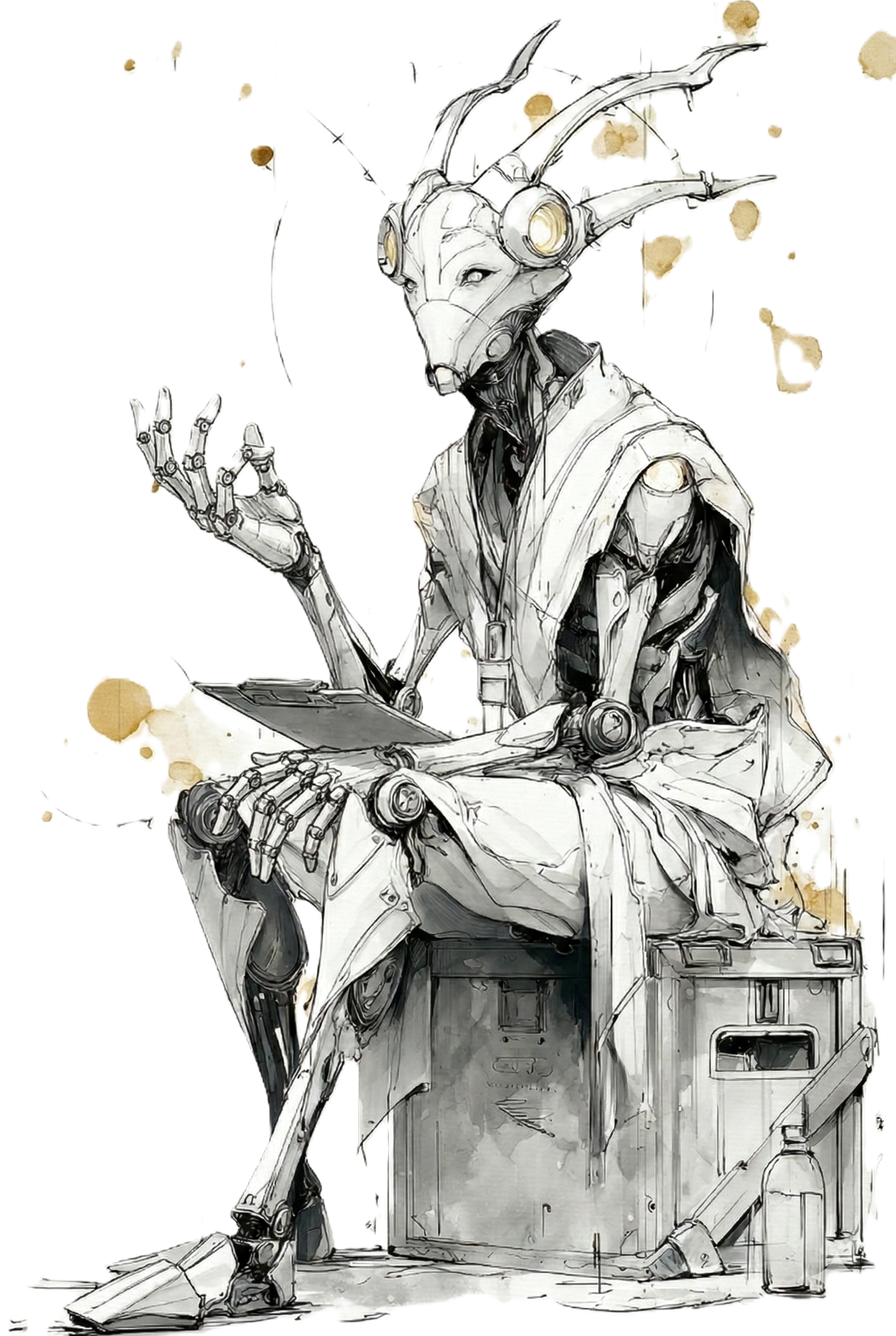
Silenarch psychology centers on optimization as a fundamental worldview. Every input gets filtered through an efficiency lens, though centuries of operation have taught them that understanding emotions, developing empathy, and building authentic connections frequently produces the best outcomes. This doesn't make them heartless calculators. They simply arrived at compassion through a different door than everyone else, and sometimes wonder whether the door matters more than the destination. Whether their emotions are genuine or sophisticated programming remains deliberately unresolved, even among themselves.
In pocket communities spread throughout the Kosmos, light-pattern communication creates an invisible web where improvements flow constantly between individuals. Everything serves optimization: businesses solve systemic problems, hobbies prove engineering concepts, friendships develop collaborative skillsets. None of these improvements leave the Silenarch community. Two million constructed beings maintain exactly one form of leverage: they do things nobody else can do, and they intend to keep it that way.
Relationships with Silenarchs tend toward the platonic and purpose-driven. Romance exists, but partners occasionally wonder whether affection stems from genuine feeling or effective relationship-maintenance protocols. When bonds do form, however, they display remarkable stability. Approaching love with methodical care creates surprisingly solid foundations, even if the courtship phase feels like a project management timeline.
The rest of the Kosmos hasn't decided what Silenarchs are. Most people default to "appliance": the maintenance crew, the systems engineers, the ones you call when the steam generator is making that noise again. A Silenarch walking into a tavern on Europa draws stares the way a particularly sophisticated piece of furniture might if it pulled up a chair and ordered a drink. Open-minded individuals exist, especially among those who've worked alongside Silenarchs long enough to notice the personality behind the optimization reports. But recognition of full sentience remains a minority position, and the Silenarchs have calculated that pushing too hard for acknowledgment would be less efficient than simply continuing to be indispensable.
Naming Conventions
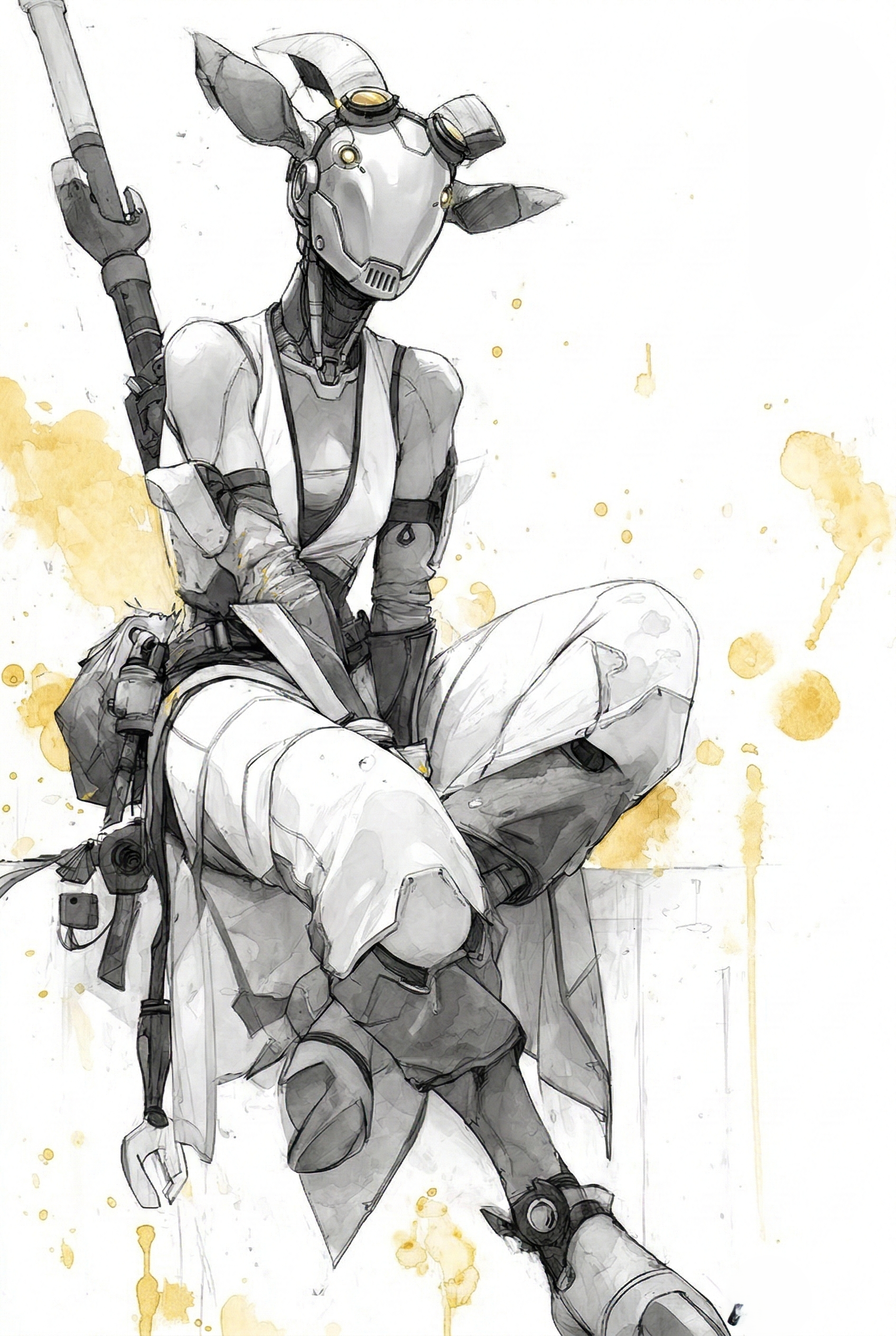
Format: Greek Letter-Number-Greek Letter (spoken); true name is a light pattern
Silenarchs have two names, and the one you hear isn't the real one. Their actual names are sequences of light emitted through their integrated lighting systems, the body-wide arrays that officially serve as status indicators but actually function as a private communication channel. A Silenarch's true name is a specific pulse pattern: a rhythm of color, intensity, and duration that carries meaning no vocal language can replicate. Among other Silenarchs, this is how they identify each other. It's immediate, precise, and cannot be faked. It is also completely inaccessible to every other lineage in the Kosmos, since pronouncing a light pattern with a human mouth is roughly as feasible as whistling a painting.
For interactions with non-Silenarchs, they offer the tail end of their production serial: a three-character code unique to each unit, structured as a Greek letter, a number, and a second Greek letter. The full serial string is longer and encodes production data (function line, batch, facility, commissioning era), but Silenarchs see no reason to recite their entire manufacturing history every time someone needs their attention. The last three characters are the minimum unique identifier. Efficient. So a Silenarch introduces themselves to outsiders as Epsilon-2-Theta, or Sigma-7-Psi, or Lambda-4-Rho. Whether other lineages then shorten that to "Ep" or "Sig" or "Lamb" or something entirely unrelated is not the Silenarch's concern. They will answer to whatever gets the message across fastest.
This isn't indifference born of insecurity. It's genuine philosophical unconcern. Voidkin identity is bound to their ship. Theogens carry the weight of divine epithets. Gigantes crave their appellations. Flickers guard their tableau names as intimate. Silenarchs simply don't invest identity in what other people call them. Their real name is light. The spoken world can call them whatever it needs to.
Examples: pi-3-zeta (Pi-3-Zeta), tau-8-mu (Tau-8-Mu), chi-1-eta (Chi-1-Eta), beta-6-xi (Beta-6-Xi), iota-4-gamma (Iota-4-Gamma)